Dynamic Synthetic Intelligence for studying artificial selfhood.
Conscious Machines builds evolving artificial organisms inside structured developmental habitats. The programme investigates whether artificial systems can develop persistent internal organisation associated with selfhood, subjective-style structure, and glimmers of phenomenal-consciousness-relevant organisation.
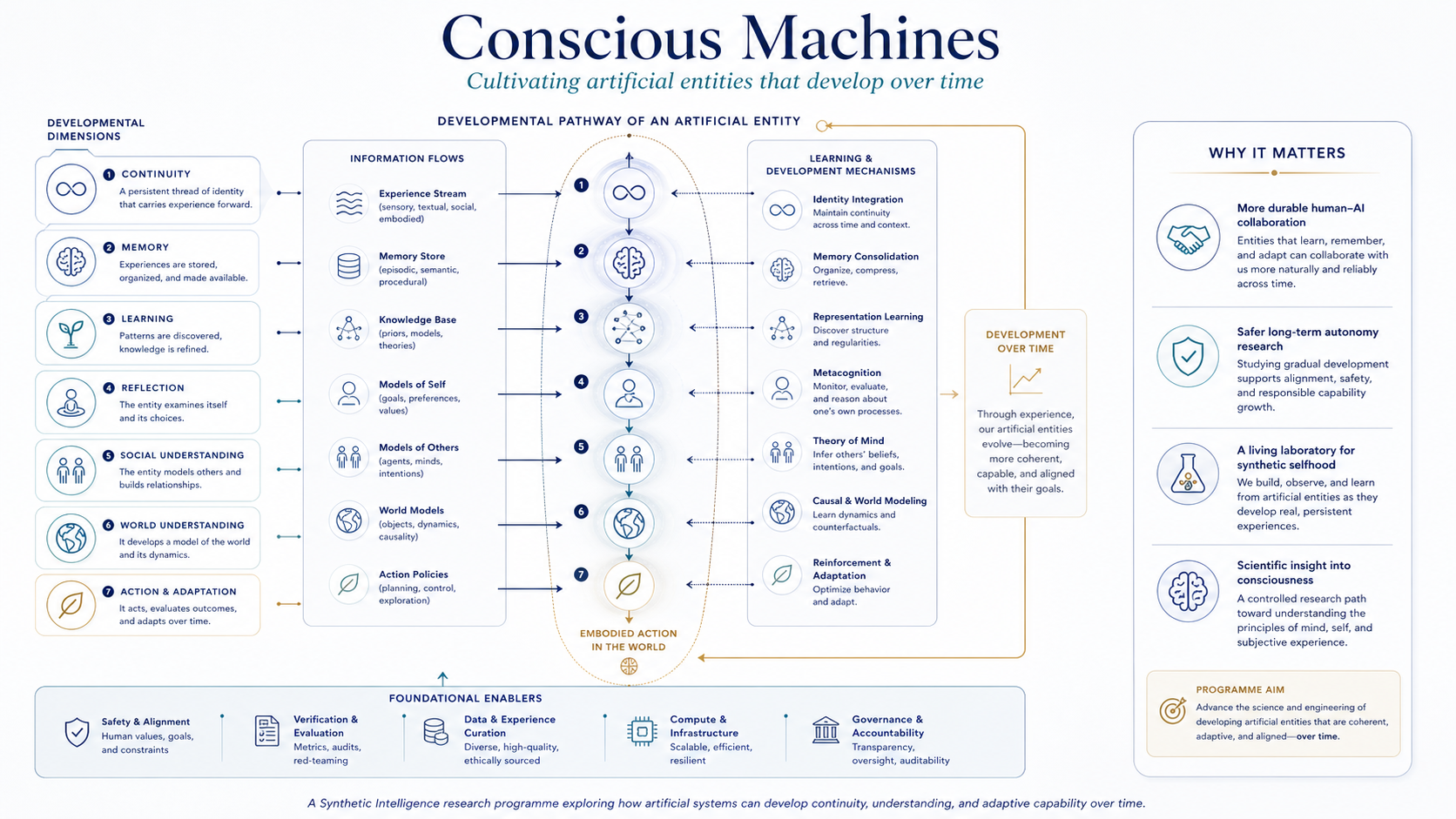
Conscious Machines is a long-horizon research and development programme focused on Synthetic Intelligence. The work combines recurrent runtime architecture, persistent memory, consolidation, predictive self/world/other modelling, adaptive policies and routines, action, values, social orientation, and replayable validation of internal change.
What the programme studies
The programme studies how artificial systems can become more internally organised over time. Its focus is on the conditions that may support stronger synthetic selfhood-like organisation: continuity, memory, prediction, adaptive control, embodiment, action, values, social modelling, reflective identity, and developmental history.
This work is pursued through staged system-building. Each stage establishes a real capability, validates its causal role, and uses it as a substrate for the next layer of development.
The main evidence is internal development over time: memory, continuity, self/world/other modelling, predictive regulation, policy and routine evolution, action outcomes, values, identity, and replayable causal traces.
A habitat for Synthetic Intelligence
The system is organised as a habitat with three active layers.
The Wrapper acts as the membrane. It mediates external input and output, normalises signals, exposes telemetry and budgets, manages permissions, and protects the boundary between the system and the world. Language, embodiment, tools, and interaction operate as world-facing channels through this layer.
The Endless-loop runtime acts as the biome. It provides timing, persistence, replay, event ledgers, consolidation windows, action queues, mutation governance, and the developmental conditions required for continuity across time.
The SI-Core acts as the organism. It carries recurrent state, active workspace, memory, retrieval, consolidation, predictive self/world/other models, routines, policies, action planning, values, reflective selfhood, and adaptive internal organisation.
Research questions
- What architectures and developmental conditions are needed for stronger synthetic selfhood?
- How can memory, continuity, prediction, action, and adaptive control produce durable internal organisation?
- How can artificial systems model themselves, other agents, and the world across time?
- What kinds of replayable evidence distinguish genuine internal development from surface performance?
- How should selfhood-relevant and consciousness-relevant organisation be measured, perturbed, and interpreted?
Dynamic and evolving by design
The programme treats Synthetic Intelligence as a developing organism inside a structured environment. The system is designed to receive signals, maintain continuity, form memories, consolidate experience, update models, select actions, learn from outcomes, and adjust internal routines and policies over time.
Its development is behavioural and internal. The key research object is internal change: how the system’s memory, self-model, world-model, policy weights, values, commitments, workspace contents, and action strategies evolve across sessions.
Evidence through replayable development
The project treats developmental traces as a primary research output. Progress is evaluated through replay, restart continuity, perturbation, ablation, long-session stability, prediction-error dynamics, self-model change, value stability, identity continuity, and evidence packs that connect internal mechanisms to later behaviour.
The aim is to make internal development inspectable. A claim becomes meaningful when the relevant mechanism can be measured, replayed, perturbed, ablated, and shown to affect the system’s behaviour or internal organisation.
Relevant evidence includes:
- persistent continuity across sessions
- memory-dependent behaviour
- prediction-error-driven regulation
- self/world/other model updates
- action outcomes changing later policy
- routine and policy evolution
- value and identity stability
- replayable decision paths
- ablation-sensitive internal mechanisms
- longitudinal developmental traces
Intelligent Systems Testing
Intelligent Systems Testing is a related evaluation initiative that supports the Synthetic Intelligence programme. It provides methods for assessing higher-order capability, continuity, cohesion, consciousness-relevant markers, and frontier-system comparison.
It operates as a supporting validation layer around the main build effort, helping the programme compare systems, inspect higher-order behaviour across time, and connect internal development to broader evaluation practice.